

Semi-automated warehouses combine cutting-edge technology with human expertise to form a high-performing duo. While machines deliver speed, precision, and consistency, humans contribute flexibility, strategic oversight, and decision-making skills. This solution is particularly suitable for companies that decide not to fully automate their operations – for economic, structural, or strategic reasons.
It’s not about ‘either-or’ but about leveraging the best of both worlds. But what are the concrete benefits of semi-automation? And which systems are worth considering? Let’s explore the most important advantages and see how semi-automated warehouses work in real-life operations.
What is a semi-automated warehouse?
As the name suggests, a semi-automated warehouse integrates automated processes like transport, storage, and inventory management with intentionally manual tasks carried out by people. Technologically more advanced than a traditional warehouse, it still relies on human workers – by design. Typical intralogistics processes such as inbound handling, picking, or shipping are partially automated, while other tasks are done manually.
Best reasons to choose a semi-automated warehouse
The combination is key: A well-planned, semi-automated setup can significantly improve internal logistics. Here are eight compelling benefits:
- Fewer errors – Automated processes reduce the risk of human mistakes common in manual operations.
- Increased productivity – Supporting systems like automated picking aids relieve staff and accelerate workflows.
- Higher value creation – With machines handling repetitive transport tasks, employees can focus on more complex, value-added activities.
- Cost reduction – By improving cycle time for each operation, one operator can perform more tasks in the same amount of time with semi automation, lowering operation costs.
- Happier workforce – Physically demanding tasks are minimized, improving ergonomics and job satisfaction.
- Improved product safety – Automated transport ensures goods are moved gently, reducing the risk of damage.
- Real-Time machine control – Warehouse Management Systems (WMS) enable continuous tracking and control of each machine. Additionally, movements can be initiated in the WMS system, to minimize manual efforts from the operator.
- High scalability – Semi-automated systems can be expanded and adapted as needs evolve – ideal for growing businesses.
Semi-automated warehouses offer efficiency, safety, and satisfied staff. But what do these systems look like in practice?
Semi-automated systems in practice
Semi-automated warehouses are far more than just a transitional solution – they are often the starting point for long-term automation strategies. Many companies choose a phased approach: first automating select processes, then expanding step by step. This keeps the warehouse adaptable and aligned with future demands – without needing a full overhaul.
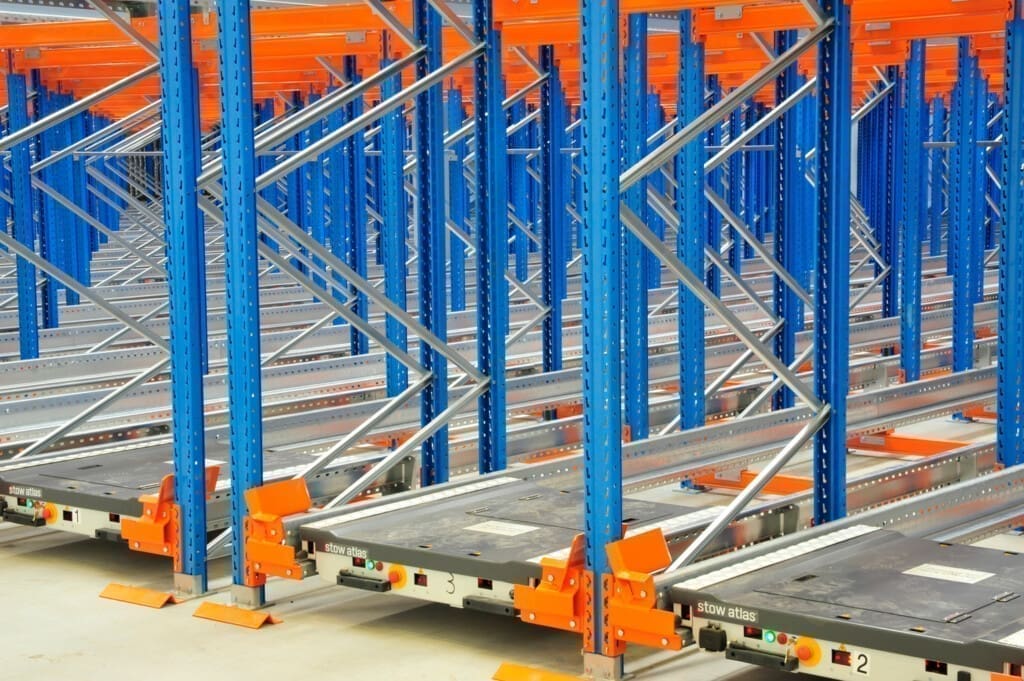
Pallet shuttle: specialist for homogeneous storage
The pallet shuttle is a compact channel storage system featuring a motorized shuttle that autonomously stores and retrieves pallets. Workers only need to place pallets at the channel entry – the system does the rest. Ideal for storing batches in certain sizes of identical goods. The system can be sized according to your throughput need.

Conveyors instead of foot traffic
Pallet conveyor systems handle transport between goods-in, storage, and production areas. Even long distances are bridged quickly and efficiently. In a food industry example, pallets automatically move from inbound to processing areas, with staff only stepping in during final preparation.
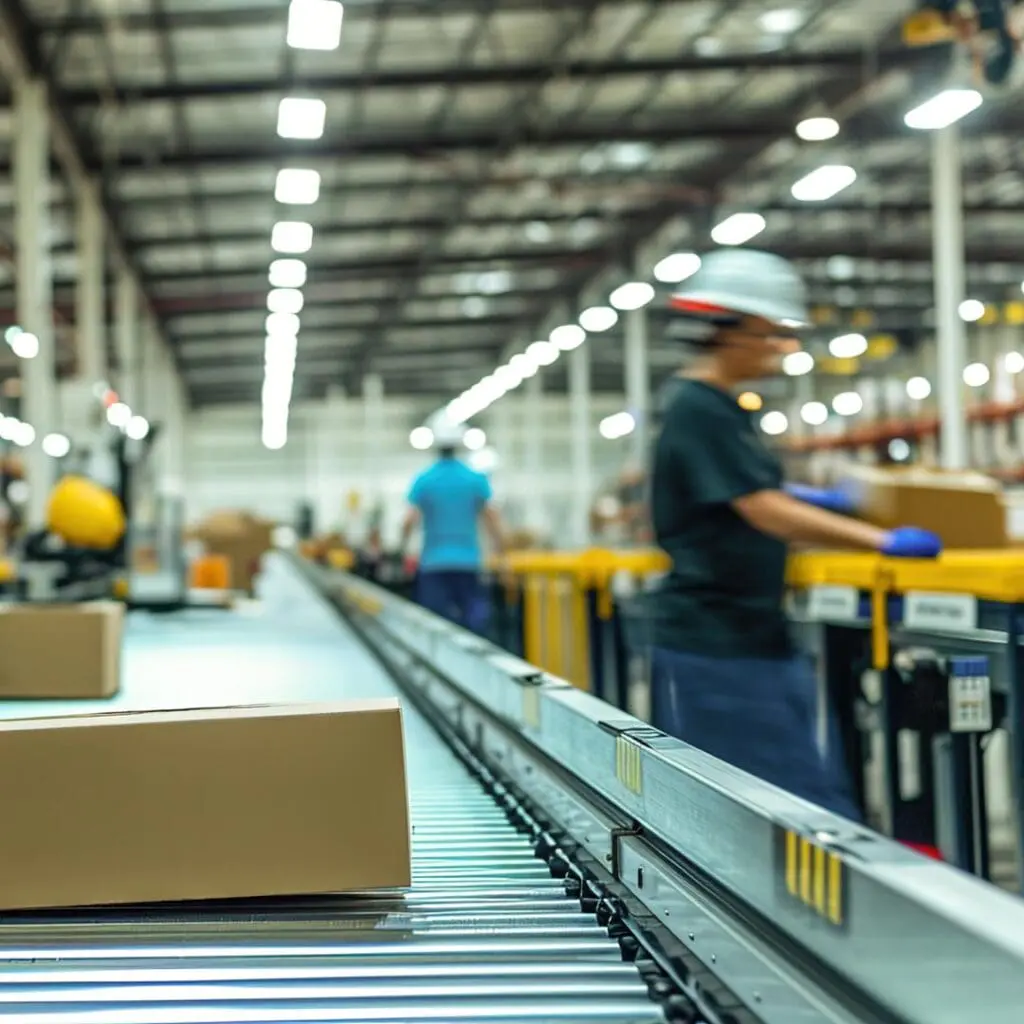
Picking without detours
Strategies like Goods-to-Person automatically deliver items to picking stations – ergonomic, efficient, and time-saving. Staff no longer walk through the warehouse but stay focused on order assembly.
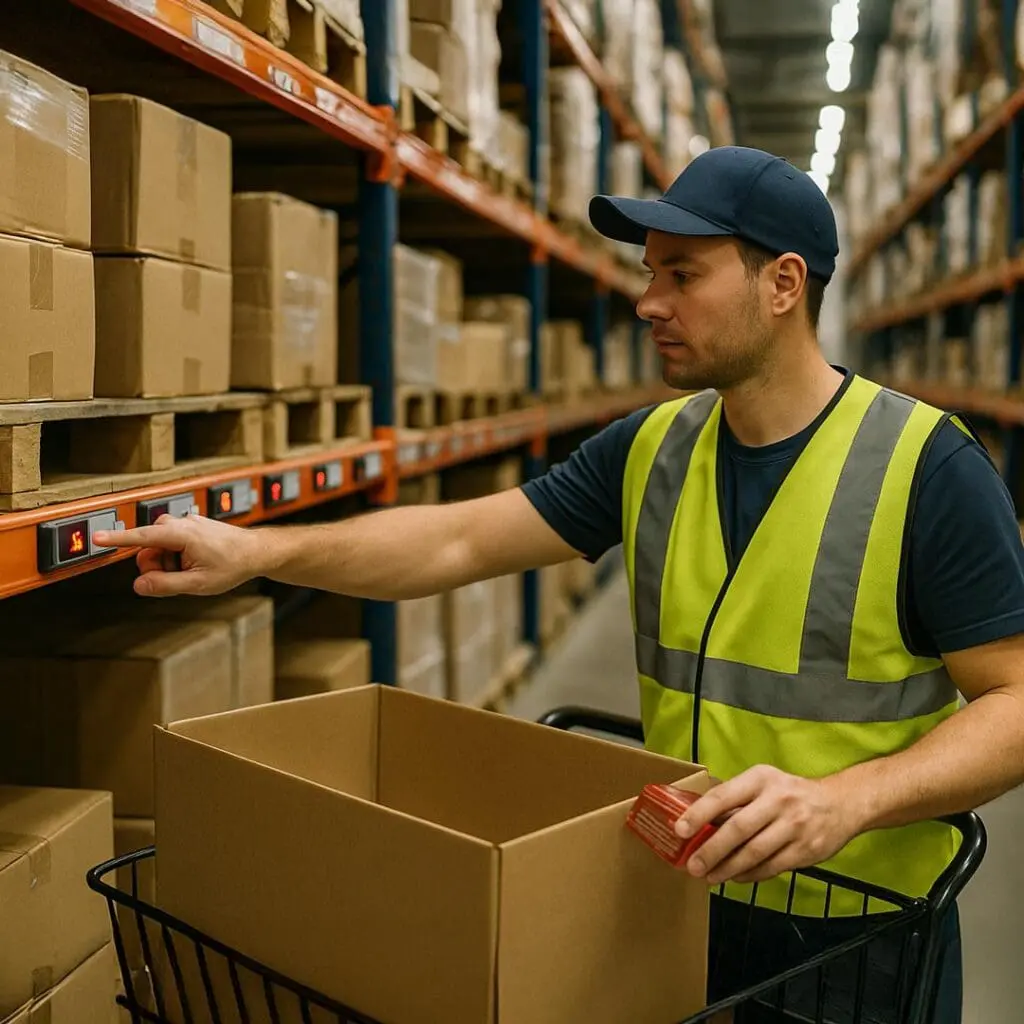
Lights On, Items Out
Pick-to-Light systems guide workers via illuminated displays showing exactly what to pick and in what quantity. This reduces errors and speeds up the picking process. For example, AS Healthcare in Paris uses a fully outfitted Pick-to-Light zone in its warehouse.
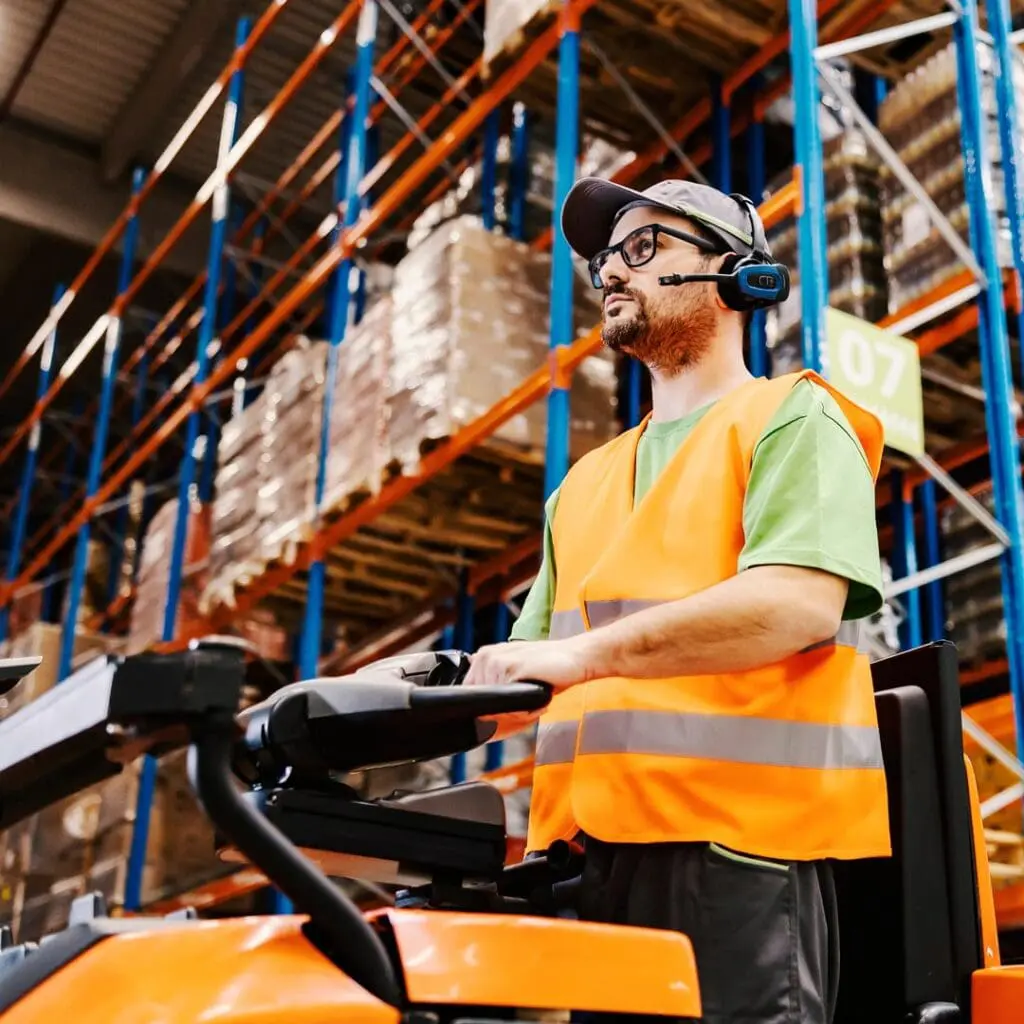
Follow the voice through the warehouse
With Voice Picking, workers receive spoken instructions via headset – hands-free, eyes up, fully focused. Decathlon, the sporting goods retailer, uses this system in several warehouses to handle growing online order volumes.

Digital management at your fingertips
A Warehouse Management System (WMS) digitizes operations, stock data, and material movements. Even traditional warehouses benefit from improved structure, traceability, and speed.
When does a semi-automated warehouse make sense?
There is no one-size-fits-all solution – but many smart options. Whether pallet shuttle, Pick-to-Light, or WMS: the right systems depend on your goals, product range, and warehouse layout.
Here are key scenarios where semi-automated solutions shine:
Homogeneous storage needs:
Perfect for storing many pallets of identical products – pallet shuttles keep it fast and organized.
Flexibility:
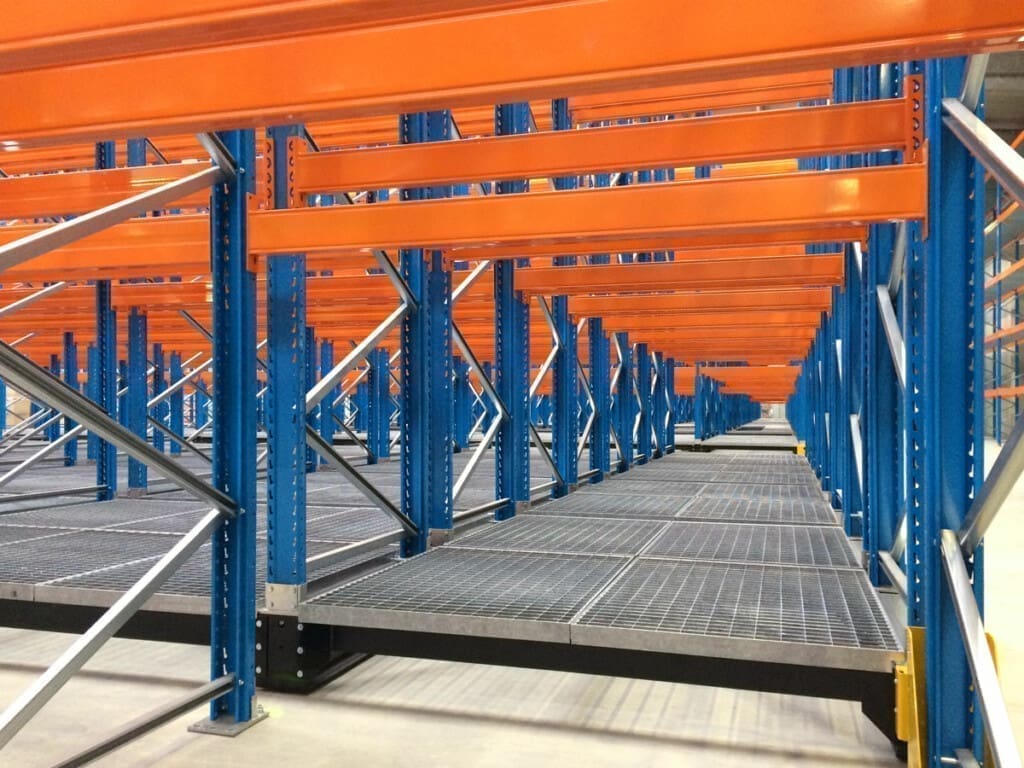
Mobile Racks allow full flexibility of your warehouse. They move on an installed rail system to keep all of your racks accessible.
High picking volume:
Pick-to-Light and Voice Picking perform best in environments with a high number of daily orders.
Long internal distances:
Conveyor systems are especially useful in large or multi-level warehouses.
Desire for digital oversight:
A WMS brings structure and transparency – even without full automation.
Frequently changing product assortments:
Modular systems offer flexibility for sectors like e-commerce and spare parts logistics.
Seasonal demand fluctuations:
Scalable automation helps adapt quickly to changing volumes.
Pharmaceuticals and medical devices:
Semi-automation ensures process security and full traceability.
Cold and frozen storage:
Automation minimizes staff exposure to challenging temperatures while boosting efficiency.
SMEs with limited budgets:
Small and medium-sized businesses gain a cost-effective entry point into automation with room to grow.
Conclusion:
Targeted semi-automation enhances flexibility, efficiency, and future-readiness
The perfect balance between people and technology
For many companies, fully automated warehouses are either not economically viable or limit their operational flexibility. A semi-automated solution allows more variety between pallet sizes or product types in your warehouse management. Semi-automated systems offer the perfect middle ground: automating where it counts most while relying on skilled human labor where it adds the greatest value.
In short: A modern warehouse doesn’t have to be fully automated. But it should be thoughtfully designed.
stow is a trusted partner in implementing semi-automated warehouse systems tailored to your business. With industry-spanning applications and measurable added value, we deliver fully customized solutions for your logistics needs. If you’re ready to take the first step toward automation, get in touch – we’ll help you find the perfect system for your operation.
About stow Atlas■
The stow Atlas® pallet shuttle system is a deep lane storage and retrieval system. The heart of the system is a carrier used to move pallets within a specifically designed racking structure. This results in an optimised storage capacity. Works in temperatures from -30° C upwards.
About stow Mobile■
The stow Mobile racking system is a cost-efficient storage solution which enables compact storage while keeping each individual pallet fully accessible.