
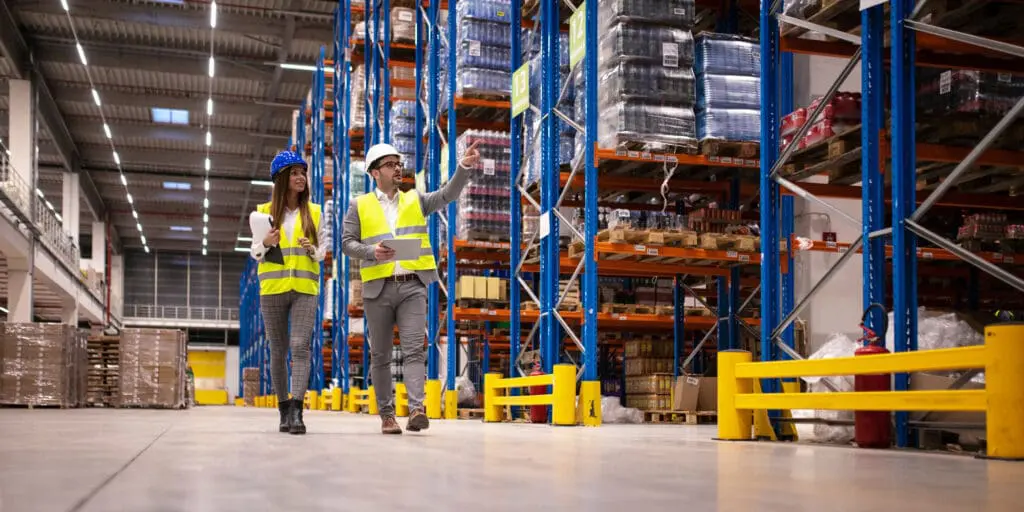
Warehouse racks carry enormous loads and often tower above staff and equipment. If they are damaged or misused, the consequences can be devastating: dangerous collapses, injuries, or costly damage. That is why rack safety in warehouses has the highest priority.
To reduce risks, clear standards and regulations have been developed. They require regular inspections and define safe procedures for daily warehouse operations. By complying with these standards, you not only protect people and goods but also make the best use of the available warehouse space. Proper rack safety also prevents downtime caused by accidents. In many European countries, compliance with these safety standards is expected – and in some cases, even legally required. This article explains what the requirements are and how you can integrate them into your warehouse operations.
DIN EN 15635 explained: Scope and rules
Introduced in 2008, EN 15635 is the key European standard for the safe use and maintenance of static steel storage systems, such as pallet racking and industrial shelving. It provides warehouse operators and logistics companies with clear guidelines on how to operate racking systems safely throughout their entire lifecycle.
The standard has been adopted into national law across Europe. This ensures uniform safety standards in the DACH region, the Benelux countries, France, Spain, the UK, and many other countries.
Who does DIN EN 15635 apply to?
In short: to all businesses that use pallet or steel racks. The standard therefore concerns rack manufacturers, warehouse planners and installers – but above all warehouse operators, who are responsible for safe day-to-day use.
It is important to note that DIN EN 15635 applies only to static steel storage systems. Other storage methods, such as block stacking or automated storage systems, are subject to separate standards.
DIN EN 15635 covers the entire lifecycle of a rack – from correct installation and assembly to ongoing operational and maintenance requirements. Its goal is to preserve the structural integrity of racks and protect the people working around them.
The standard deals with operational safety, not structural calculations. It complements design standards such as EN 15512, ensuring that once a rack has been properly designed and installed, it is also used and maintained safely in everyday operations.
In short: Compliance with DIN EN 15635 significantly reduces the risk of rack collapses and warehouse accidents.
Is compliance with DIN EN 15635 mandatory?
Officially, EN 15635 is a voluntary standard, but compliance is regarded as best practice and is often indirectly required.
For example, under British health and safety law, employers must keep work equipment safe. Following EN 15635 is the recognized way to meet this obligation. Ignoring it may lead to scrutiny by the authorities in the event of an accident.
In Germany, steel racks are classified as work equipment that must be inspected regularly by a competent person under §10 of the Industrial Safety Ordinance (BetrSichV). Following EN 15635 essentially fulfills this legal requirement.
Across Western Europe, insurers, regulators, and auditors also expect warehouse operators to comply with the standard.
In short: Ignoring EN 15635 is a liability. In addition to safety and health risks, companies may face fines, insurance issues, or reputational damage if a preventable rack collapse occurs.
Warehouse safety according to DIN EN 15635: Key requirements
DIN EN 15635 defines clear responsibilities and procedures to ensure that racking systems remain safe in everyday warehouse use. The key requirements for operators include:
- Appointing a PRSES
Each warehouse must designate a Person Responsible for Storage Equipment Safety (PRSES).
- Responsible for the safe operation of all racks
- Coordinates inspections, keeps records, decides on corrective measures
- Their name must be communicated to all warehouse staff
- Regular Inspections
The standard requires a two-tier inspection system:
- Internal visual checks:
carried out regularly (e.g., weekly or monthly), depending on traffic and forklift activity - Expert inspection:
at least once a year by trained professionals or certified inspectors, with a detailed report and, in some cases, a safety label
- Damage Assessment with a Traffic-Light System
- Green:
minor damage – monitor and record - Amber:
moderate damage – repair promptly; area must not be reloaded until fixed - Red:
severe damage – unload immediately, cordon off, replace components
- Load Capacity and Use
- Racks must be clearly marked with load capacity signs
- Overloading and unauthorized modifications are prohibited
- Floor conditions, anchoring, and manufacturer specifications must be observed
- Staff Training
- Employees must be trained in the safe use of racks
- Forklift drivers: careful operation, adherence to loading instructions
- Even minor damage must be reported immediately
- Good housekeeping (clear aisles, no obstructions) is emphasized
- Maintenance and Repairs
- All damage must be repaired without delay
- Only original or approved spare parts may be used
- Preventive maintenance includes tightening bolts, re-securing base plates, replacing protectors
- Goal: keep racks permanently safe and operational
- Documentation
- All inspections, damage reports, and repairs must be documented
- Important records include: layout drawings, manuals, inspection reports, repair logs, training records
- In Germany, a rack book is often required
What other standards and regulations apply to warehouse safety?
DIN EN 15635 is part of a broader framework of rules that ensure warehouse safety. To gain a full understanding, you should also be aware of the following complementary standards and regulations:
- Design and Installation Standards
In addition to EN 15635, these standards ensure racks are properly designed and built:
- EN 15512: calculation of loads and material strengths
- EN 15620: tolerances and clearances between racks and handling equipment
- EN 15629: specifications for racking systems and their installation
- National Regulations
As an operator, you are also bound by your country’s laws:
- EU-wide: the Work Equipment Directive (2009/104/EC) requires safe use and regular inspections
- Germany: the Industrial Safety Ordinance (BetrSichV) mandates annual rack inspections; DGUV Rule 108-007 provides detailed guidelines
- United Kingdom: PUWER regulations apply; HSE guidance HSG76 recommends EN 15635 inspection intervals
- Insurance: many insurers require documented rack inspections as a condition of coverage
- Industry guidelines and best practices
Additional recommendations from industry groups can support compliance:
- SEMA (UK): code of practice with traffic-light damage classification and inspection routines
- Manufacturers and service providers: offer training and inspection services
- Extra protective measures: column guards, barriers, floor markings, end-of-aisle protection, good lighting, and forklift speed limits
- Other safety standards
Other areas of warehouse safety should also be considered:
- Fire protection: ensuring racks do not obstruct sprinklers and complying with fire codes (EN/NFPA)
- Machine safety: standards such as ISO 3691 (industrial trucks) or EN ISO 13849 (machine safety functions) help reduce risks from forklifts and automation
Warehouse safety: Conclusion and best practices
For warehouse operators across Europe, DIN EN 15635 is much more than a recommendation – it is the foundation for safe pallet racking operations.
By appointing a competent PRSES, carrying out regular inspections, addressing damage promptly, and training your staff, you create a safety culture. The benefits are clear: fewer accidents, fewer injuries, longer-lasting racks, and improved efficiency.
What else matters?
- Ensure robust design: check whether your racks were designed and installed according to EN 15512 and related standards
- Use protective systems: column guards, end barriers, or sensors to prevent or detect damage
- Document thoroughly: keep detailed records – they can be crucial in the event of an incident
- Fulfill legal requirements: regulators, insurers, and auditors in Western Europe expect compliance, and doing so shows staff and customers that you prioritize safety and quality
Combining innovation and safety
Modern technologies can further enhance safety. Automated shuttle systems or robotics, such as those from Movu Robotics (part of the stow Group), reduce risks and improve consistency. Their effectiveness, however, depends on integration with a strong safety framework like DIN EN 15635. Combining real-time rack monitoring with annual inspections allows you to detect problems earlier and verify that repairs are effective.
A continuous process
Rack safety is not a one-off task but an ongoing commitment. EN 15635 provides you with a clear roadmap. By following it consistently and continuously improving your processes, you can ensure smooth operations – whether your warehouse is manual or highly automated.
At the end of the day: well-maintained racks are the backbone of any warehouse. They secure the flow of goods, protect your staff, and strengthen morale. Use the standards to review current practices, close gaps, and raise your safety benchmarks. In doing so, you combine compliance with efficiency – a genuine win-win for your company and everyone who works there.